Vento
Fast, fluid VNC/RDP remote desktop client for Android, with touchpad-style controls and multiple client backends.
Features
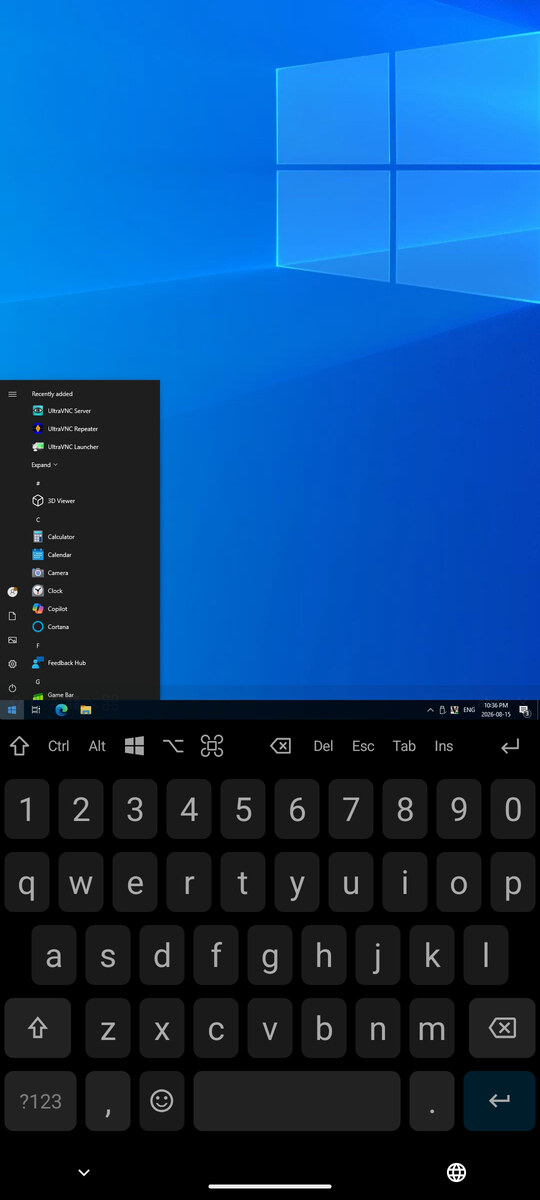
Touchpad-style controls
Tap to click, two or three fingers to right or middle click, double-tap then drag to drag, two fingers to scroll, and pinch to zoom. You can also fling the cursor.
Accuracy assists
Improved precision for slow motion, axis locking, adaptive acceleration, and hovering.
Keyboard and mouse
Physical keyboards and mice are supported, with proper modifier and layout handling. The extension keyboard provides keys missing on soft keyboards.
IME fixes
Workarounds for composition and newline bugs in various Android IMEs.
Multiple backends
Multiple open-source libraries for VNC, RDP and SPICE are included. Each connection can use a different one.
Hardware acceleration
H.264 is decoded by the device where the server supports it, with the FreeRDP and TigerVNC client backends. RustDesk also supports H.265, VP8, VP9 and AV1.
Multi-window
Sessions can be opened in multiple windows, side by side with each other or another app.
Material Design 3
Follows the system colors and the light/dark theme.
Saved credentials
Saved passwords are encrypted with AES-256-GCM by a hardware-backed keystore. Server fingerprints are also stored and verified.
Desktop previews
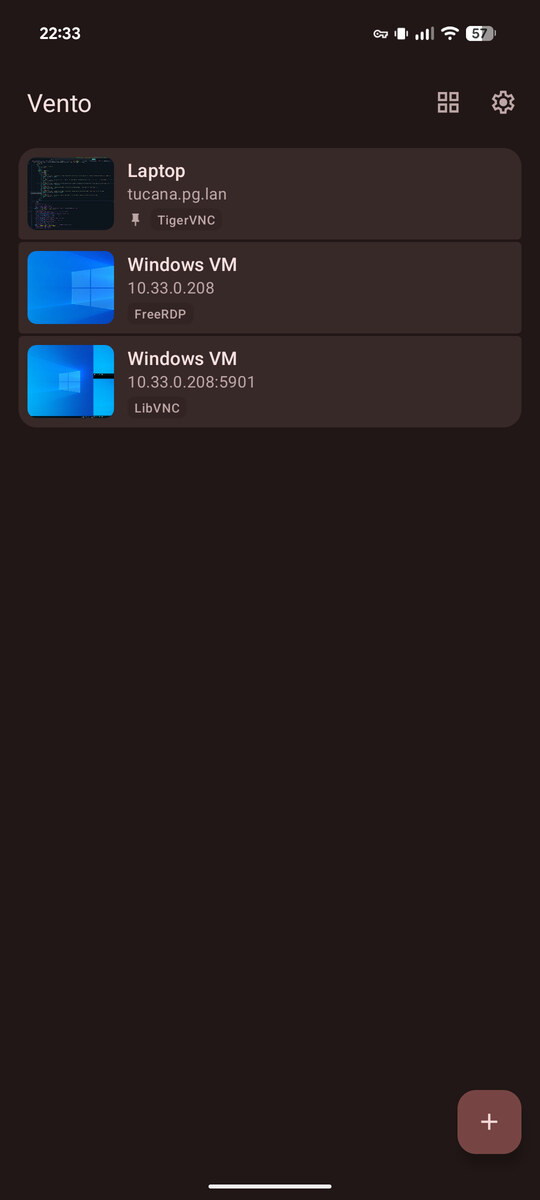
Connection cards show the last state of the desktop. The previews are stored encrypted, and can be disabled.
Clipboard
Copied text is sent to and from the remote machine. Each direction can be turned off separately.
Import and export
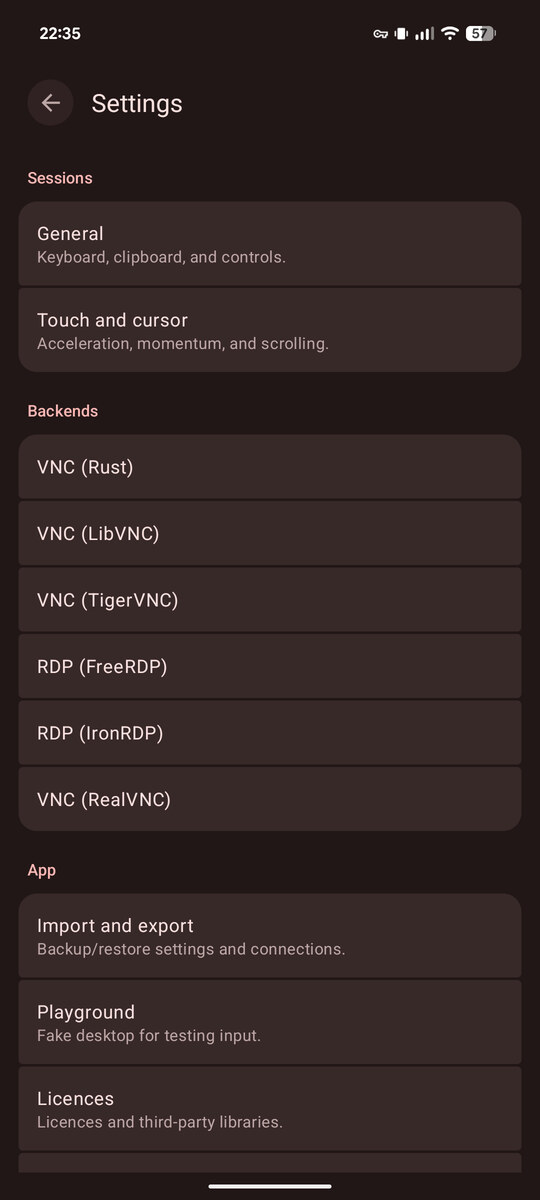
Connections and settings can be exported and imported, with or without saved passwords.
Playground
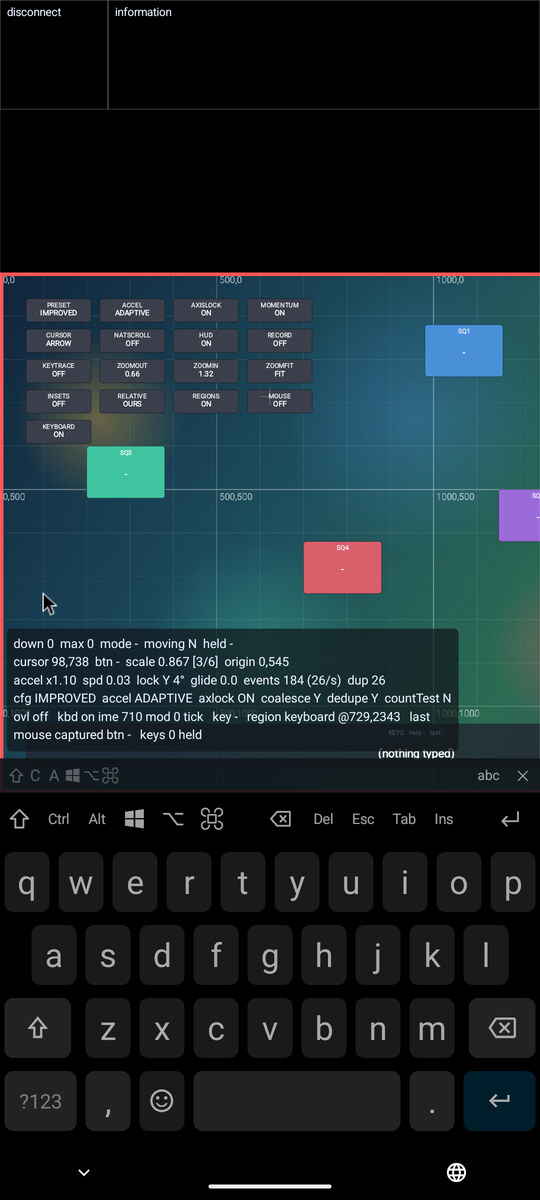
A fake desktop for testing input and adjusting the control settings without a server.
Open source
GPL-3.0, no ads, no tracking, and reproducible builds. The control library is MIT so it can be used in other apps.
Backends
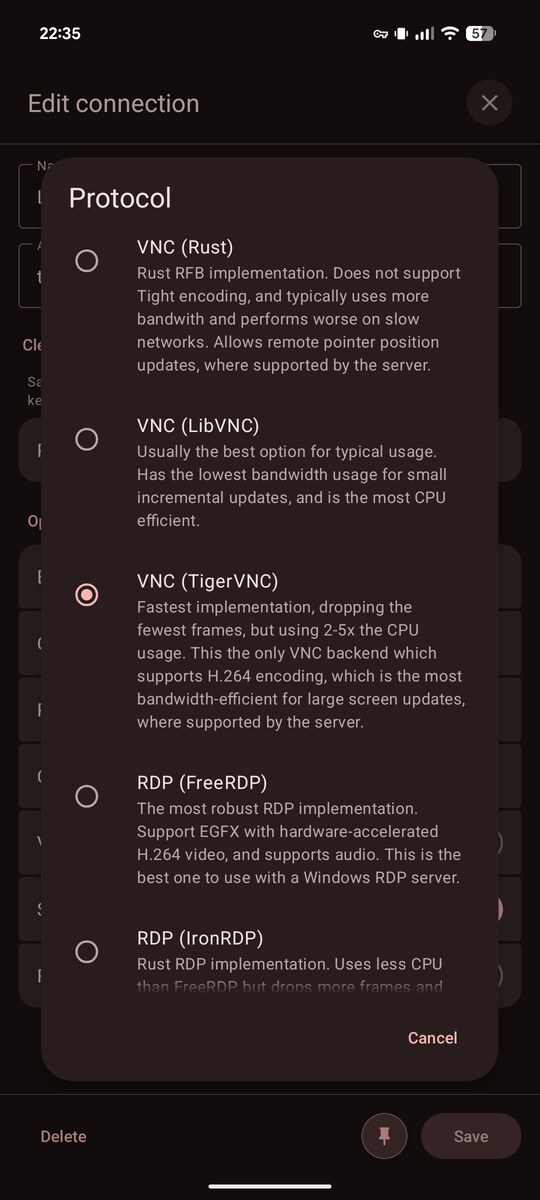
Each connection can use a different client implementation.
LibVNCVNC
Usually the best option for typical usage. Has the lowest bandwidth usage for small incremental updates, and is the most CPU efficient.
TigerVNCVNC
Fastest implementation, dropping the fewest frames, but using 2-5x the CPU usage. This is the only VNC backend which supports H.264 encoding, which is the most bandwidth-efficient for large screen updates, where supported by the server. It also supports QEMU audio.
RustVNC
Rust RFB implementation. Does not support Tight encoding, and typically uses more bandwidth and performs worse on slow networks. Allows remote pointer position updates, where supported by the server.
FreeRDPRDP
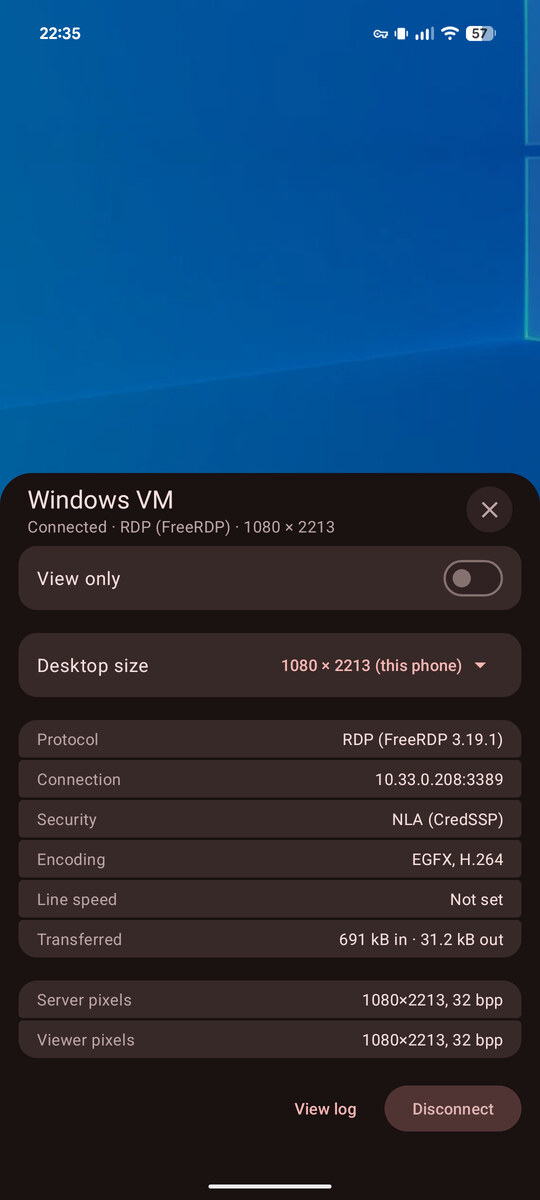
The most robust RDP implementation. Supports EGFX with hardware-accelerated H.264 video, and supports audio. This is the best one to use with a Windows RDP server.
IronRDPRDP
Rust RDP implementation. Uses less CPU than FreeRDP, but drops more frames and does not properly support EGFX.
SPICESPICE
Usually used for QEMU/libvirt/Proxmox virtual machines. Supports clipboard and screen resizing if the guest agent is running.
RealVNCVNC
RealVNC's proprietary client implementation. This is the only one which supports UDP, ZRLE2, and RealVNC's proprietary authentication/encryption. It performs significantly better than the others when connecting to a RealVNC server.
RustDeskRUSTDESK
RustDesk backend supporting direct or rendezvous connections. Uses hardware-accelerated video codecs
RealVNC plugin
The RealVNC backend is a separate APK since RealVNC's client library is proprietary and can't be redistributed. The standalone plugin does not contain the client library either, and you will need to provide a RealVNC APK (e.g., from APKMirror) to use it.
DownloadScreenshots
What's new
Version 6
- TigerVNC: Update to dd416cbf.
- FreeRDP: Update to 3.32.0.
- FreeRDP: Update OpenSSL to 3.5.8.
- LibVNC/TigerVNC: Update libjpeg-turbo to 3.2.0.
- LibVNC/TigerVNC: Update nettle to 4.0.
- IronRDP: Update to 9b151c4c.
- SPICE: Update ryll to 3ba0f24.
- TigerVNC: Fix Tight decoding with older servers.
- TigerVNC: Support the QEMU audio extension.
- FreeRDP: Require TLS 1.2 and 2048-bit keys by default.
- FreeRDP: Add option to allow legacy TLS.
- FreeRDP: Show negotiated security layer and graphics pipeline version in the info panel.
- IronRDP: Improve compatibility with third-party servers.
- IronRDP: Improve disconnect messages.
Version 5
- Update app metadata.
Version 4
- Internal bugfixes and refactoring.
- Tweak two-row extension keyboard layout.
Version 3
- Add hover assist based on cursor changes.
- Add toolbar option for session controls.
- Add two-line extension keyboard option.
- Allow option/command keys to be hidden.
- Fix IPv6 issues with some backends.
Version 2
- Add SPICE backend.
- Enable AnonTLS VNC auth for LibVNC and TigerVNC.
- Add button to share a full-size screenshot.
- Fix in-app plugin uninstall button.
- Apply input setting changes to existing sessions.
- Improve panning behaviour, add option to add margins.
- Add more reset options.
- Implement app shortcuts and home screen pinning.
Version 1
- Initial release.